Lineage 2 Attribute System – Complete Guide – Now Including Freya and High Five Attribute System Updates!
Elemental Attribute System Overview
Table of Contents
Attribute Types and Opposite Elements
The attribute system is designed to provide an additional way to affect the damage output of each character in both PvP and PvE, through the use of regular and skill attacks. There are 6 attributes in total – 4 to represent the elements of nature and 2 which are called alignment attributes.
Attributes are coupled together in mutual exclusive opposites, as follows:
| Fire Attribute | Water Attribute | |
|---|---|---|

|

|

|
| Earth Attribute | Wind Attribute | |

|
|

|
| Dark Attribute | Holy Attribute | |

|
|

|
Attributes can affect both the attack and the defense of a character. The attribute damage dealt by an attacking character to a defending character is equal to the difference between the attacker’s attack attribute and the defener’s attribute resistance (which is the total value of defense attributes). More about this later.
Applying Attributes. Attribute Items
Apart from skills with a built-in attribute, buffs providing an increase in attack or defense attributes, and attributes received through skill enchant, you can also add attributes to your weapons and armor set pieces (excluding shields, shirts, belts, cloaks, accessories, headgears and so on). Only S-Grade and higher grade items can have attribute effects applied to them.
To do that, you need to use attribute items. There are currently two types of those items – attribute stones and attribute crystals. When you apply attribute items successfully, you increase either the attack or defense attribute value of an item. Attributes applied to weapons add to your attack attribute value and those applied to armor pieces count towards your attribute resistance values in your stats window.
| Fire Stone | Water Stone | Earth Stone | Wind Stone | Dark Stone | Divine Stone |
|---|---|---|---|---|---|

|

|

|

|

|

|
| Fire Crystal | Water Crystal | Earth Crystal | Wind Crystal | Dark Crystal | Divine Crystal |
|---|---|---|---|---|---|

|

|

|

|

|

|
To apply an attribute item simply double click it while it’s in your inventory. You can also drag it onto your toolbar and use it just like other items, such as healing potions.
Changes in the Attribute System on Freya
Until Freya, you could only apply a single attribute to an armor piece. On Freya and High Five, you can apply 3 different attributes to each armor piece, but there are some limits to this, as follows:
- You can apply one type of attribute only once per armor piece. For instance, you can only apply Fire to one of the 3 attribute slots that are available on each armor piece.
- You cannot apply opposite element/alignement attributes to a single armor piece. For instance, you cannot put both Fire and Water on one armor piece.
Other changes on Freya include a decrease in the overall damage bonus that attack attributes provide. For more information on this, look at the damage breakpoint graphs further down below.
Attribute values and levels
The maximum attribute value for a weapon is currently 300 and the maximum value of a single attribute on armor pieces is 120.
Attribute values are also categorized in levels, depending on the current attribute value on a weapon or armor piece. Attribute stones can increase the attribute values of weapons and armors up to level 3. Attribute crystals can increase the attribute above level 3 and up to level 6.
The increase amount for each successful use of attribute stones/crystals is 6 attribute points for weapons and 5 for armor pieces. The only exception to this is the initial attribute application to weapons that have no attribute. In that case, the first successful use of attribute stones on a weapon increases its attribute by 20.
Weapon attribute levels go as follows, with the values for each level and the number of attribute items needed to reach the next level:
| Screenshot | Weapon Attribute Level | Attribute Value Range | Number of attribute items needed to reach the next level | Attribute item type |
|---|---|---|---|---|
|
1 | 0 – 25 | 2 | Attribute Stone |

|
2 | 25 – 75 | 10 | Attribute Stone |

|
3 | 75 – 150 | 15 | Attribute Stone |

|
4 | 150 – 175 | 5 | Attribute Crystal |

|
5 | 175 – 225 | 10 | Attribute Crystal |

|
6 | 225 – 300 | 15 | Attribute Crystal |
Here’s a screenshot of a maxed out weapon’s attack attribute value: 
And now for the armor piece attribute levels:
| Screenshot | Armor Piece Attribute Level | Attribute Value Range | Number of attribute items needed to reach the next level | Attribute Item Type |
|---|---|---|---|---|

|
1 | 0 – 12 | 2 | Attribute Stone |

|
2 | 12 – 30 | 3 | Attribute Stone |

|
3 | 30-60 | 5 | Attribute Stone |

|
4 | 60 – 72 | 2 | Attribute Crystal |

|
5 | 72 – 90 | 3 | Attribute Crystal |

|
6 | 90 – 120 | 5 | Attribute Crystal |
And here’s a screenshot of an armor piece with maximum resistance to a an attribute: 
The total amount of attack attribute and attribute resistance given by weapons, armor pieces, accessories (i.e. RB jewelry), potions and skills can be seen in the Character Status Window (accessed by Alt+T).
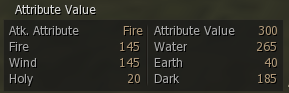
Important note: Applying attribute items to armor pieces increases resistance to the opposite element. E.g. if you use a Fire attribute stone on your Draconic Gloves, it will increase the amount of Water defense they provide while you’re wearing them.
Attribute Enchant Chance
The chance to successfully use an attribute item (stone or crystal) is not 100%. From my research and testing it seems to vary between 40% and 60%. One tip I can give is this: get a good amount of stones/crystals before enchanting your weapons/armors.
I don’t know if it’s some probability theory or just the way chance works, but if you try to use just a few stones/crystals at a time (say, 2-3), you are relying on sheer luck a lot more. If you use a decent number of stones/crystals (e.g. 15-20), in a row without pausing, the overall success rate rounds up at around 50-60% nearly all the time. It’s the same for any kind of chance-based action really.
Anyway, failing to enchant your items would not result in loss of attribute level or the destruction of your item.
Attribute Master NPC – Attribute Potions and Attribute Stones/Crystals Exchange
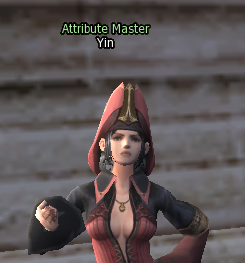
The Attribute Master NPC provides a couple of services in relation to the attribute system. There are currently two Attribute Master NPCs – in Aden outside the Blacksmith Shop and in Rune Castle Town just north of the Gatekeeper.
You can buy attribute potions for any of the 6 attribute elements from those NPCs. These potions give you a 10 minutes buff which increases the attribute resistance for the element of your choice by 30.
You can also exchange attribute stones for the same number of attribute stones of the opposite type for free, i.e. water stones for fire stones. Crystals cannot be exchanged this way though.
On High Five, you now also have the option to exchange attribute stones for attribute crystals. The rate of exchange is 5 single-type attribute stones plus 3 million Adena for 1 Crystal of the same attribute.
Lastly, the NPC gives you the option to remove an attribute from your weapon or armor piece for a small fee. This way you can apply new attribute to your items if you want to.
Getting Attribute Stones and Attribute Crystals
Attribute stones are acquired through hunting mobs in the higher level zones around the Aden continent such as Isle of Prayer and Hellbound, as well as inside instances like the Coral Garden, Crystal Caverns and other. In High Five, you can acquire attribute stones at more hunting grounds.
Of course you can also find both stones (and crystals) on sale by player shops in towns. Based on the difficulty in getting the different types of attribute stones, the most expensive ones tend to be Earth/Wind, followed by Divine/Dark and the cheapest are usually Fire/Water stones, but this is not always the case anymore, depending on the server.
Acquiring and Crafting Attribute Crystals
Since the Freya Update, Attribute Crystals drop in various high level hunting grounds, but on pre-Freya servers they can’t be dropped from mobs and can only be acquired through crafting. The recipes for the craft can be bought from NPC Officer Tolonis in Keucereus Base located on the Gracia continent.
Each attribute element’s recipe costs 600k Adena and 200 Extracted Red Starstones. The recipes are added to your Common Craft book, so any class can learn and use them. The crafting cost for 1 attribute crystal is 20 Energy Compression Stones (ECS).
You can get ECS by going into the Seed of Destruction and Seed of Infinity when they’re open and look for NPCs called Seed Energy. There are 6 types of those spawning randomly and each type corresponds to each attribute element – Fire, Water, Earth, Wind, Dark and Divine. You can easily distinguish each type by looking at the NPC’s name, for example “Seed Energy – Fire”.
To farm ECS from these NPCs you need a Collection Agathion which can be obtained by either buying a Shadow Collection Agathion (which expires after a set amount of time) from Officer Tolonis or by getting a regular Collection Agathion as a reward from the Hall of Suffering instance in the Seed of Infinity.
Here is a more detailed article on how to access the Seed of Destruction and some tips on gathering Energy Compression Stones: How To Get Attribute Crystals
Items, Buffs and Skills Attribute Calculation Priority. Servitor Attack Attribute Inheritance
While attribute resistance is calculated in a pretty much straightforward way by simply accumulating all defense attribute values coming from items and skills, the attack attribute calculation is more involved and has some rules and restrictions.
Before we see how the final attack attribute is applied, let’s look at the different sources of attack attribute values.
Attributes of Attack Skills and Attribute Skill Enchant
Some attack skills of different classes have a built-in attribute which defines the type of damage dealt to a target.
Example: Tyrant’s Burning Fist has a Fire attribute and therefore it deals Fire damage to a target.
Other skills have no attribute and so they deal non-attribute damage. This can be modified via Skill Enchantment which gives the option to enchant many of the skills for different attribute elements.
Example: Tyrant’s Force Blaster is a non-attribute skill by default, but if enchanted for Fire, it would obtain a Fire attribute and thus deal Fire damage.
The amount of total attack attribute value which each skill contributes is equal to a combination of its default attribute (or lack of) and the level of attribute skill enchantment.
Example: Burning Fist with its default Fire attribute adds 20 Fire attack attribute points by default, while Force Blaster with its non-attribute property doesn’t add any attack attribute points.
Skill enchanting can increase the attribute of an attack skill by up to 50 points (at +30 skill enchant level). Roughly, you get an increase of 1-2 attribute points per enchant level.
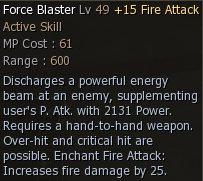
Example: Let’s say you enchant Burning Fist for Fire and you reach skill enchant level of +15. This is an increase of about 25 Fire attribute points and it’s added to Burning Fist‘s default which is 20 Fire attribute points. The overall Fire attack attribute of Burning Fist becomes 45.
With Force Blaster as an example and a Fire skill enchant level of +15, you add 25 Fire attribute points to the skill’s default which is 0 in this case, so you get a final Fire attack attribute of 25.
In the case where you enchant a naturally attributed skill to a different attribute than its own, the skill enchant attribute route overwrites the natural attribute.
Example: You enchant Burning Fist (which provides a default of +20 Fire attack attribute) up to +15 on the Wind Attack skill enchant route. The overall attack attribute bonus of the skill becomes +25 Wind and the natural Fire attribute is ignored completely.
Note: All attack skills with a built-in attribute have a default attack attribute value of 20.
Attack Attribute Buffing Skills and Effects
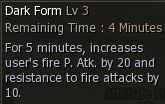
Buff effects from skills and items (i.e. potions) which increase the attack attribute of a character play a role in the final calculation of attribute damage. An example of such a skill is the Tyrant’s Dark Form which increases the Fire attack attribute by 20 and the resistance to Fire damage by 10.
Attack Attribute Priority and Calculation
OK, so how do attack skills, buffs and weapons work together to calculate the final attack attribute you have? The answer lies in the priority which each of them has to one another:
- Attack skills ALWAYS deal the type of attribute damage they have, whether it’s default or from skill enchanting. When their natural/default attribute and skill enchant attribute matches, the two are combined. When they don’t match, only the skill enchant attribute value is used.
- If your weapon’s attribute matches your skill’s attribute, the values of the two are added together. E.g., a Demon Splinter fist weapon with 150 Fire attribute and Burning Fist which has default Fire attribute of 20 would result in total Fire attack attribute of 170.
- If your weapon’s attribute does not match your attack skill’s attribute, the attribute of the weapon is ignored in the final calculation. Taking the previous example, the total Fire attack attribute would be only 20.
- Your weapon’s attribute always takes priority during regular attacks (aka normal hits), regardless of the attack attribute a buff effect increases. E.g., Dark Form which increases Fire attack attribute by 20 would not have any effect if you use a Demon Splinter fist weapon with 150 Holy attribute during regular attacks.
- If your attack skill attribute matches the attribute increase from a buff effect, the two are added up together, regardless of whether your weapon’s attribute is the same or not. E.g., Dark Form adds 20 Fire attack attribute, Burning Fist adds another 20 Fire attack attribute and your 150 Holy weapon is ignored, giving a total of 40 Fire attack attribute.
- If the attack attribute of your weapon, buff effect and attack skill is the same, all 3 are added together for the final result.
Here’s a simple table to showcase all possible scenarios, using Fire and Holy attributes as examples:
| Weapon Attack Attribute | Attack Attribute Increase From a Buff | Attack Skill Attribute | Final Attack Attribute During Regular Attack | Final Attack Attribute During Skill Attack |
|---|---|---|---|---|
| Fire +150 | Fire +20 | Fire +20 | Weapon + Buff = 170 Fire | Weapon + Buff + Skill = 190 Fire |
| Fire +150 | Holy +20 | Fire +20 | Weapon only = 150 Fire (ignores Buff attribute) | Weapon + Skill = 170 Fire (ignores Buff attribute) |
| Holy +150 | Fire +20 | Fire +20 | Weapon only = 150 Holy (ignores Buff attribute) | Buff + Skill = 40 Fire (ignores Weapon attribute) |
| Holy +150 | Holy +20 | Fire +20 | Weapon + Buff = 170 Holy | Skill only = 20 Fire (ignores Weapon and Buff attributes) |
| Fire +150 | Fire +20 | Non-Attribute | Weapon + Buff = 170 Fire | Skill only = Non-attribute (ignores Weapon and Buff attributes) |
Although the basic calculation of attribute damage is the attacker’s attack attribute minus the defender’s attribute resistance, the relationship is not exactly linear and there are breakpoints where the damage increase is significant followed by plateaus without any increase in damage. See the next section for details.
Servitor Attack Attribute Inheritance
The 3 Summoner classes (Arcana Lord, Elemental Master and Spectral Master) share their weapon’s attack attribute with their servitors. At any time when a servitor is being used, it gains 80% of it’s master’s weapon’s attack attribute, while the master has the remaining 20% for him/herself.
Example: An Arcana Lord has a 300 Fire attribute weapon and has summoned Feline King. Feline King automatically gains 240 Fire attack attribute while the Arcana Lord has 60 remaining for his/her own attacks.
Servitor attack skills follow the same priority rules for attributes as player characters.
Servitors of other classes (Hell Knight, Maestro, etc.) do not gain any attributes from their masters’ weapons.
Attribute Breakpoints
The increase in damage from attributes is dependent on the difference between the total attack attribute of the attacking character and the total defense attribute of the defending character. These totals are calculated by adding up all sources of attribute values: weapons, armor pieces, accessories, potion effects, buff effects, skills and so on.
To get the final attribute value you have to subtract the total of all defense attributes from the total of all attack attributes. The final attribute cannot go below zero.
Example 1: A regular attack with a 150 Fire attribute weapon + a buff that increases Fire attack attribute by 20 equals to 170 Fire attack attribute in total. The defender is a character that has 20 Fire resistance from a passive skill + 60 Fire resistance from an armor piece = 80 Fire resistance in total. The final attribute value is 170 – 80 = 90 Fire attribute which is then used to increase the damage dealt to the defender.
Example 2: A skill attack with a 75 Dark attribute weapon + a buff that increases Dark attack attribute by 20 equals + a Dark attribute skill which adds another 20 equals to 115 Dark attack attribute in total. The defender is a character that has 20 Dark resistance from a passive skill + 120 Dark resistance from an armor piece + 30 Dark resistance from a potion making its its Dark resistance 170 in total. The final attribute value is 115 – 170 = 0 (can’t go below zero) Dark attribute which has no effect in the calculation of damage dealt to the defender. In other words – total resistance to this particular Dark attack.
To make it easier to grasp, let’s imagine the attacked in Example 1 is the defender in Example 2 and vice versa. Here’s a table that shows the final attribute values if both characters attack each other simultaneously:
| Weapon | Buff | Attack Skill | Passive Skill | Armor | Potion | Total Attack Attribute | Total Attribute Resistance | |
|---|---|---|---|---|---|---|---|---|
| Char 1 | 150 Fire | 20 Fire | N/A (Regular Attack) | 20 Dark | 120 Dark | 30 Dark | 170 Fire | 170 Dark |
| Char 2 | 75 Dark | 20 Dark | 20 Dark | 20 Fire | 60 Fire | N/A | 115 Dark | 80 Fire |
End result: Char 1 attacks Char 2 with 170 Fire and Char 2 resists 80 Fire, which equals to 170 – 80 = 90 total Fire attack attribute. Similarly, Char 2 attacks Char 1 with 115 Dark and Char 2 resists 170 Dark, which equals to 115 – 170 = 0 total Dark attack attribute.
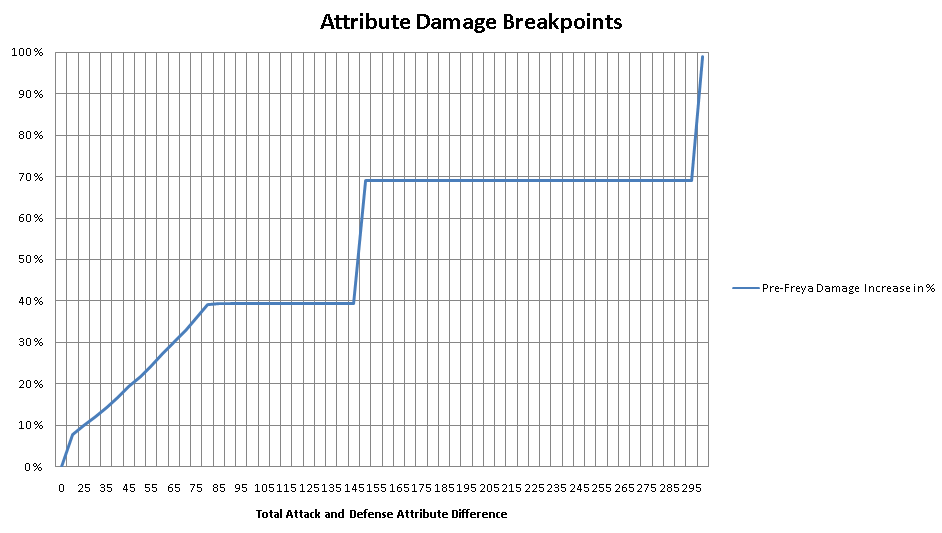
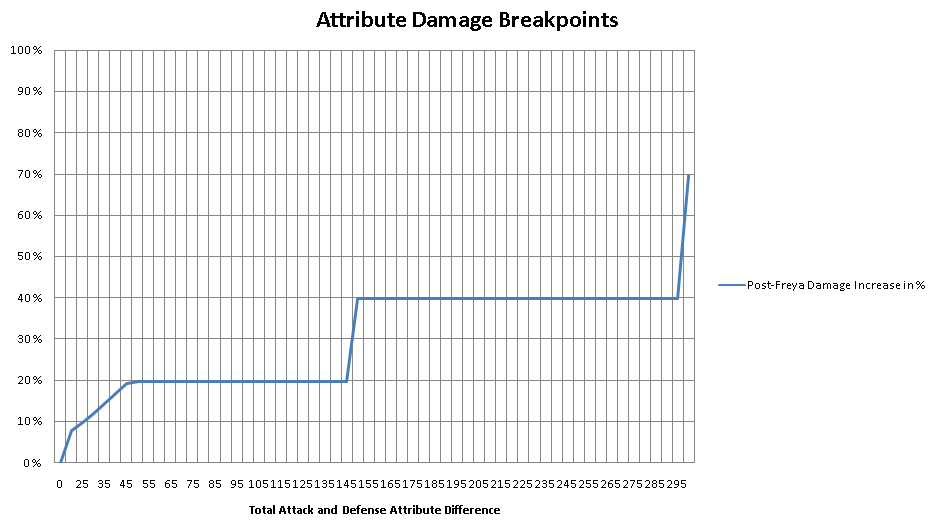
Once the final attack attribute is calculated, it is used to increase the damage dealt by a cerain percentage. That percentage is not linear as can be seen from various tests done by players. There are so called breakpoints and plateaus where the damage increase is either significant or non-existant.
Next we’ll see some graphs which show how the damage is increased in relation to the final attribute value calculated after taking all attack and defense attributes into account. You will get a an idea of how the positive effect of attributes on attack damage was decreased in the Freya update.
Pre-Freya Attribute System Breakpoints Graph
First let’s see how it works on servers prior to Freya, before the update of the Attribute System (click onto the image to see it in full size):
Post-Freya Attribute System Breakpoints Graph
Now let’s see how it works on Freya and High Five servers, after the update of the Attribute System (click onto the image to see it in full size):
Comparative Difference Graph of Attribute System Breakpoints – Before and After Freya
Finally, let’s see the relative difference of damage increase bonus before and after the Freya update (click onto the image to see it in full size):
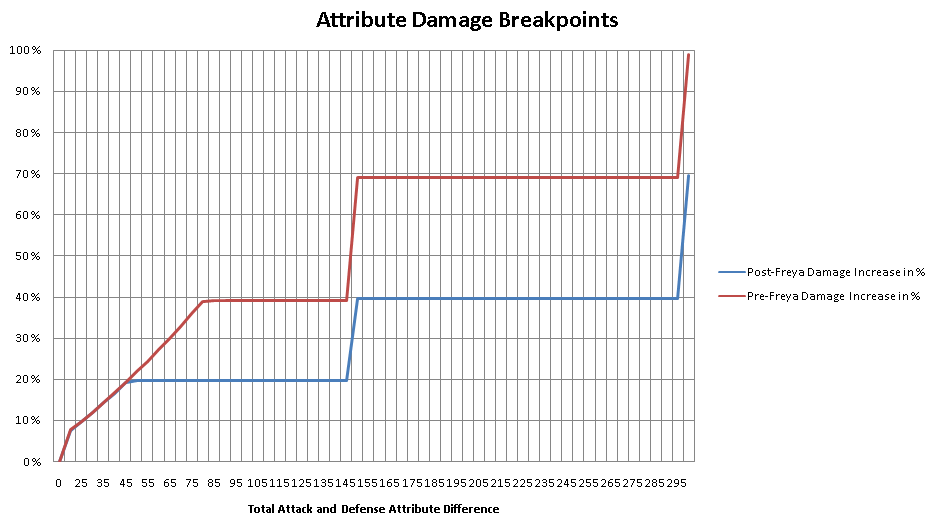
So basically, once you have your final attack attribute after subtracting all the attribute resistances, you can use the graphs to see what increase in damage you will deal or receive.
You can download the Excel 2007 spreadsheet that I used to create these graphs:
Download Attribute System Breakpoints (Updated) Excel Spreadsheet
If you’re interested, here are some helpful posts, articles and discussions about the attribute system’s breakpoints:
http://www.pirateninjas.net/articles/lineage-2/elemental-attribute-defence-test/
http://www.l2guru.com/forum/showthread.php?t=122599
http://www.l2guru.com/forum/showthread.php?t=122605
PvE and Monsters Attributes
The way damage is decresed or increased via attributes is different in PvE compared to PvP, both before and after the Freya update. Before the update, it was possible to get close to complete resistance against monster’s attribute attacks, but after the update that resistance has its limits.
I do not have enough information to confirm what that limit is with a 100% certainty, but it appears that you cannot get past the 20% damage breakpoint, at least against most of the new high level monsters.
Most of the monsters and NPCs in Lineage 2 have different built-in attack and defense attributes (ranging from 20 to 160 as far as I know), so these are taken into account during attribute calculation in the same way as between player characters.
Many of the different monster types are vulnerable to a certain attribute while resistant to its opposite. The table below shows some of those relations between monster types and attributes, but those do not always hold true. Some monster categories have no definite attributes connected to them, so they were omitted – Magic Creatures, Animals, Beasts, Giants, Humanoids and Dragons.
There are also monsters who may have vulnerability to one attribute, but not be resistant to its opposite, as well as monsters who may not comply to the attribute resistance and weakness typically assigned to their category.
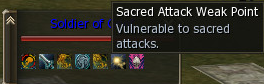
If you want to make sure, always check the monster’s actual attribute vulnerability/resistance by opening its status window.
| Category | Undead | Demons | Plants | Bugs | Angels | Fairies | Spirits |
|---|---|---|---|---|---|---|---|
| Symbol |

|

|

|

|

|

|

|
| Weak to | Holy | Fire | Dark | – | Opposite Element | ||
| Resists | Dark | – | Holy | Wind | Same Element | ||
Typical PvP Attack Attributes for All Classes
These are just the typical attributes seen on most servers, but don’t take them for granted. Besides.
Although some classes are limited to the attribute element they can use if they want to take advantage of a certain naturally attributed attack skill, some other classes are completely free to use whatever they want. It really depends on what your server meta is or in other words – what your opponents use on their armors.
If you spot any wrong attack attributes for a class, please let me know by posting in the comments below.
Human
| Class | Attribute |
|---|---|
| Duelist | Fire/Water/Earth/Wind |
| Dreadnought | Earth |
| Phoenix Knight | Holy |
| Hell Knight | Dark, but can also use Fire/Water/Earth/Wind if not relying on Judgement too much |
| Adventurer | Fire/Water/Earth/Wind |
| Sagittarius | Fire |
| Archmage | Fire |
| Soultaker | Dark |
| Arcana lord | Fire |
| Cardinal | Holy |
| Hierophant | Holy |
Elf
| Class | Attribute |
|---|---|
| Eva’s Templar | Water |
| Sword Muse | Holy |
| Wind Rider | Fire/Water/Earth/Wind |
| Moonlight Sentinel | Wind |
| Mystic Muse | Water |
| Elemental Master | Water |
| Eva’s Saint | Holy |
Dark Elf
| Class | Attribute |
|---|---|
| Shillen Templar | Wind/Dark |
| Spectral Dancer | Holy (PvE), Earth (PvP) |
| Ghost Hunter | Fire/Water/Earth/Wind |
| Ghost Sentinel | Fire/Water/Earth/Wind |
| Storm Screamer | Wind/Dark |
| Spectral Master | Wind/Dark |
| Shillien Saint | Holy |
Orc
| Class | Attribute |
|---|---|
| Titan | Fire |
| Grand Khavatari | Fire |
| Doomcryer | Fire |
| Dominator | Fire |
Dwarf
| Class | Attribute |
|---|---|
| Maestro | Earth |
| Bounty Hunter | Earth |
Kamael
| Class | Attribute |
|---|---|
| Doombringer | Dark |
| Soul Hound | Dark |
| Trickster | Fire/Water/Wind/Earth |
With the help of http://lt-klanas.com/forum/showthread.php?t=19120





256 Responses to Lineage 2 Attribute System Complete Explanation – Updated to Include Freya and High Five Changes!